.webp)
.webp)
.webp)
.webp)
.webp)
.webp)
.svg)
.svg)
.svg)
.png)


.png)


%201.svg)

State of Simulcast: The Evolution of Podcasts into Video
Published
January 12, 2026
Updated
January 12, 2026


[tldr]
Simulcasts explained: The big takeaways
- Simulcasts are podcasts distributed in both audio and video formats, representing an evolution—not a replacement—of traditional podcasting.
- Simulcast adoption has scaled rapidly across platforms like YouTube and Spotify, now accounting for a significant share of top podcasts.
- Advertisers typically buy simulcasts using bundled audio + video impressions, though audience quality, geography, and measurement differ by format.
- Attribution for simulcasts remains imperfect, especially on video platforms where pixel-based tracking is limited or modeled, which is why using multiple measurement methods often produces the best results.
- Simulcast performance varies widely and depends on audio-to-video impression mix, audience geography, execution, and discoverability dynamics.
[/tldr]
Podcasts have historically been dominated by audio consumption, but even in those early days a handful of shows (see: TEDTalks, TWiT, The Joe Rogan Experience, Rooster Teeth Podcast) were publishing not only as audio but video as well, in what our industry started calling “simulcast” shows.
In this context, a simulcast is a podcast that is available in both audio and video formats, often posted on platforms like YouTube, with a video element accompanying the traditional audio.
Between 2020 and 2022, simulcasts began gaining meaningful traction. The metrics illustrate that as the podcast ecosystem grew, so did simulcasts. According to Pew Research Center, a 2023 study found that half of the top ranked podcasts release some form of video.
Data from Spotify corroborates this growth:
- 2023: 100k+ simulcasts on the platform
- June 2024: 250k+ simulcasts on the platform
- November 2025: 500k+ simulcasts on the platform
With more shows adding a video component, it’s critical for advertisers to understand how this shift is reshaping the channel. This article explores:
- Where audio and video shows are today in the podcast landscape
- What marketers need to think about when planning in the channel
- Where simulcast shows could be headed
What is a simulcast?
For simplicity, throughout this article, video podcasts will be referred to as “simulcasts.” Across the industry, video podcasts are also referred to as “vodcasts,” “vidcasts,” and other variations. Beyond naming conventions, there are multiple ways simulcasts are executed today:
- Host on camera (example: The Toast)
- Static image or show logo/tile art (example: The Daily)
- Graphics and UI only (example: Truly Criminal)
Each execution comes with its own benefits and tradeoffs:
- Host on camera
- Pros
- Human connection: Viewers can read facial expressions, body language, and tone.
- Engagement: Higher watch times due to the visual presence of hosts (compared to static images or graphics/UI only).
- Versatility: Can be clipped into engaging short-form video (Reels, TikToks).
- Brand building: Hosts become recognizable personalities.
- Can integrate ads/products into the video.
- Cons
- High production cost: Requires camera setups, lighting, editing.
- On-camera performance pressure: Hosts must be visually presentable and comfortable.
- Pros
- Static image or show Logo/tile art
- Pros
- Low effort and cost: Easiest to produce—just export the audio with a single image.
- Focus on audio: Viewers treat it like a traditional podcast.
- Quick turnaround: Great for daily or high-volume publishing.
- Cons
- Unlikely to hold viewer retention: Almost no visual engagement—users may as well switch to audio-only platforms.
- Not algorithm-friendly: YouTube and social platforms tend to deprioritize static visuals.
- No differentiation: Hard to stand out without dynamic visuals or personalities.
- Pros
- Graphics and UI only
- Pros
- Visually engaging: Keeps attention through animations, waveforms, captions, etc.
- Anonymous or audio-first hosts: Great for hosts who don’t want to be on camera.
- Polished aesthetic: Feels deliberate and designed, which boosts credibility.
- Cons
- Moderate production lift: Requires editing skills and tools (After Effects, VEED, Descript, etc.).
- Time-consuming: Each episode may take longer to finish depending on complexity.
- Harder to personalize: No face = potentially less emotional connection.
- Pros
Where simulcasts live
When people think about watching podcasts, YouTube is often the first platform that comes to mind—and for good reason. Roughly 60% of simulcast consumption happens there (source: Podscribe Performance Benchmarks Q3 2025). However, viewing also occurs across Spotify, Apple Podcasts, Rumble, Twitch, X (formerly Twitter), and more.
These platforms can find creative ways to get involved, too: earlier in 2025 Dear Media and X partnered to launch Khloe Kardashian’s new show, where episodes premiered on X for 24 hours before hitting other platforms. And, while full episodes are not typically published to TikTok or Instagram Reels due to the nature of content being shorter on those platforms, both serve as great discoverability tools as well.
What marketers need to know about simulcast advertising and attribution
With the growing adoption of simulcasts, and fragmented consumption options, it’s crucial for marketers to understand the implications and adapt to these changes to safeguard their efforts.
If you’re focusing on direct response performance in the channel, key considerations span across: buying, tracking, execution, audience experience, and performance.
Buying
Cost
The standard right now in purchasing simulcast shows, is for impressions to be priced against one consistent CPM, with total “impressions” per episode (which can include downloads, streams, plays, views, etc.) combined across audio and video.
Audience
What isn’t accounted for in lumping these impressions together, is if the quality of audio and video audience is the same, or if it differs. The video portion of an audience may skew younger, or could be more internationally based than the audio audience, which could impact targeting strategies for brands.
However, anecdotally across clients at Right Side Up for performance-driven campaigns, experience suggests that the audience feels similar, at least with performance markers.
Brands that struggle to see results from traditional YouTube influencer campaigns often see stronger performance from simulcast placements, indicating closer alignment between video simulcast viewers and audio listeners.
And, according to Sounds Profitable’s report Video’s Rise in Podcasting, “Audio Primes (those who listen to more than 75% of their podcasts) and Video Primes (those who watch more than 75% of their podcasts) are demographically very similar.”
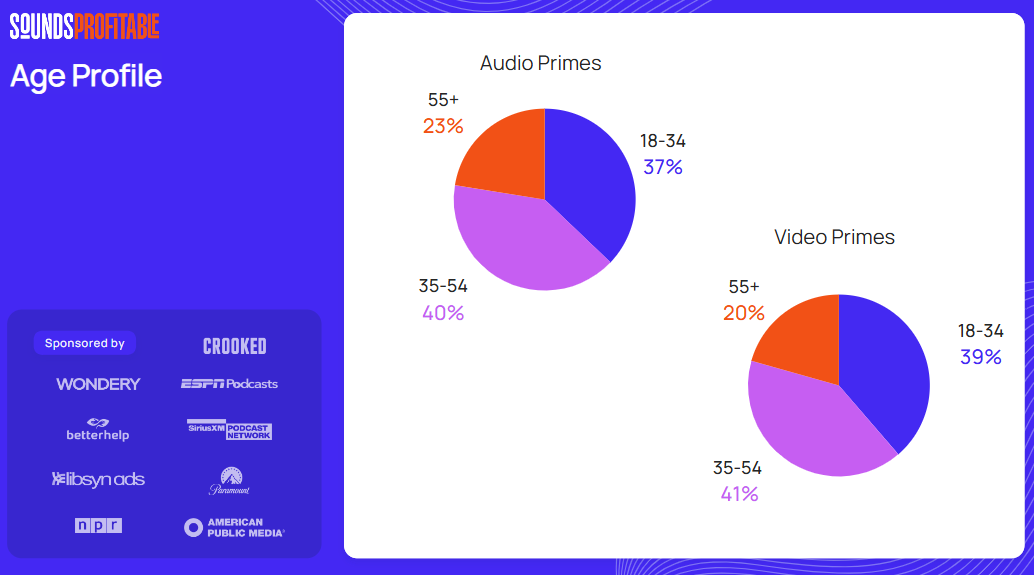
Taken together, bundling impressions across audio and video remains a reasonable contracting approach, for now, provided CPMs stay aligned with audio benchmarks.
Tracking
Pixel-based attribution
Podcast measurement has made meaningful progress with widespread adoption and trust of pixel-based attribution. Unfortunately, right now, pixel tracking does not function the same way on video platforms like YouTube, where 1x1 pixels are not accepted, creating gaps in direct attribution for simulcast video impressions. Despite this challenge, attribution companies have found a way to model pixel-based audio activity and apply that to the corresponding video impressions, giving us a more holistic view of simulcast performance from a pixel viewpoint.
Direct + survey-based attribution
If not using pixel-based attribution, marketers may use promo codes or vanity URLs alongside post-purchase surveys to calculate the activity from channels. Though historically reliable for true audio-only podcasts, simulcast shows pose a problem in surveys.
If a consumer watches a podcast on YouTube, they may be unclear on whether they should select “Podcast” or “YouTube” in a post-purchase survey. And if “YouTube” is included to capture simulcast viewers while a brand is also running YouTube pre-rolls or influencer campaigns, responses can easily conflate multiple tactics, leading to less understanding of multiple marketing channels.
As the lines blur on what a podcast really is (based on where it is consumed), survey-based attribution becomes less reliable and having overlapping forms of attribution becomes even more important.
All in, as consumer patterns change, so will our measurement tactics.
Execution
Historically, networks that sold Dynamic Ad Insertion (DAI) across full audio catalogs have faced challenges extending that same model to video. Unlike audio, video ads on YouTube must be inserted into specific episodes rather than dynamically served across an entire catalog. This limitation gave rise to hybrid selling models such as “DAI 1-week full audio catalog + video embedded episodic,” which attempted to bundle audio scale with video exposure.
That structure may soon change. In September, YouTube announced plans to allow creators to “dynamically insert brand segments into swappable slots”. So, the observed hybrid selling model, such as "DAI 1-week full catalog + video embedded episodic" may now, with YouTube’s new development, again change the way networks can bundle and sell the audio+video impressions.
This shift comes with clear trade-offs. On one hand, more consistent ad delivery across audio and video could improve alignment between platforms, particularly compared to hybrid models where execution and listener/viewer experience differ meaningfully by format. On the other hand, some of the key advantages of video-embedded episodic placements may be diminished. These include:
- A stronger share of voice relative to DAI audio-only impressions, since platforms like YouTube have historically featured lighter ad loads, and
- The evergreen nature of episodic video ads, which can continue driving value long after an episode’s initial release
Another important executional consideration is that most simulcasts are still sold as audio-first buys. Even when a show includes a visual component, advertisers are typically purchasing an audio-first ad. Leaning into the visual layer, such as having hosts display a product on screen, often comes at an additional cost and is not standard practice. That said, brands can usually provide supplemental visual assets (e.g., logos, B-roll footage) to enhance the video version of an ad at no extra charge. Additionally, while advertisers may be accustomed to pre-approving YouTube influencer content, this level of creative approval is generally not part of the standard process for simulcast buys.
Audience engagement
Because they offer fewer ads than traditional podcast DAI models (for now), video platforms like YouTube have become a favorite among some audiences. Additionally, these platforms allow for interaction through comment sections, a feature that adds an important layer of community engagement. This is something that podcast-only platforms are beginning to incorporate more, such as Spotify, which is testing comment sections and social features for its shows.
From a show growth perspective, recording a visual element opens new doors for audience engagement, but also content promotion. For hosts, the opportunity to create short-form clips for TikTok and Instagram Reels can boost discoverability. And publishing simulcasts presents the possibility for viral moments, especially on YouTube. Shows that have a strong visual component are more likely to get picked up by the platform’s algorithm, which can lead to massive organic growth—and more potential customers hearing or seeing your ad.
Performance
Earlier in the article, it was noted, based on research from Sounds Profitable, that audio and video podcast consumers are demographically very similar in terms of age and gender. However, demographic similarity does not guarantee similar performance across audio and video platforms. There are several additional factors tied to how and where audiences consume content that can materially impact campaign outcomes.
Audio vs. video impression split
One of the most important variables is the percentage of purchased impressions that run in audio versus video. Maintaining a healthy share of audio impressions remains critical. More and more networks are presenting new opportunities as “podcast” buys where the breakdown is heavily skewed—sometimes as extreme as 1% audio and 99% video. These types of “simulcasts” warrant extra scrutiny.
This imbalance also has implications for measurement. YouTube pixel attribution relies on modeling performance from audio activity, and the smaller the audio audience, the less statistically significant data exists to accurately model video performance, ultimately impacting the reliability of attribution.
Geographic location of the audience
Geography is another key consideration, particularly for brands that operate exclusively within the U.S. In those cases, non-U.S. impressions represent media waste. Many audio agreements require pricing based on U.S. impressions, but video impressions exist in a much greyer area. In some cases, networks don’t even have direct access to video geo data, as it is only available to channel owners (i.e., creators or hosts).
Experience from YouTube influencer campaigns, where geo data is typically shared by the host, shows that YouTube audiences often skew more international than podcast audiences (though not universally). However, without access to exact data, networks can, as a result, quote U.S. audience percentages based on podcast data and assume those same splits apply to video, which is frequently not the case.
Reach and discoverability
One of the clear advantages of simulcast media is YouTube’s recommendation algorithm. By surfacing content based on watch history, engagement signals, and viewing behavior, the platform enables users to discover podcast content they might not otherwise encounter – expanding reach for both shows and advertisers. However, these viewers are often less intentional than traditional podcast listeners and may not have a strong initial connection to the host or content. That said, if the content resonates, algorithmic discovery can lead to repeat consumption and long-term audience growth. YouTube also introduces the possibility of virality, something that rarely occurs in audio-only podcasting.
To close out, it’s important to note that simulcast performance varies widely. Many simulcast campaigns perform exceptionally well, while others consistently miss performance benchmarks. Outcomes depend heavily on the factors outlined above, as well as show-specific dynamics. Adding to this complexity, Podscribe’s Performance Benchmarks Q3 2025 report included early signals suggesting that audio campaigns may be more efficient at driving performance than simulcast campaigns. Subsequent publication of deeper level data confirmed that those signals persist.
The TL;DR for brands advertising in the space
For brands navigating the simulcast landscape, a few core principles can help ensure investments are both intentional and effective:
- Format and audience: Understand what type of video component they will feature. Is it actually the host? Or something else? Be mindful of the geographic breakdown of the audience for simulcasts. If your brand operates solely in the U.S., avoid overpaying for a show with a substantial international audience, especially on the video side. The video portion of a simulcast is more likely to have a wider, global reach compared to the audio component.
- Attribution: If you rely on pixel attribution, make sure that the audio audience for the simulcast is large enough to give you accurate modeling for video impressions. If using a survey, think through how the consumer talks about the channel and how they may respond, and how that might skew results.
- Execution: Ensure that the assets you provide (e.g., logos, B-roll footage) are up-to-date and compliant with the platform’s requirements. Be clear about video-specific requests, such as including CTAs on-screen or in the video description box. Keep in mind that most simulcast buys are still audio-first, and visual integrations may require additional investment.
- Performance: Pay close attention to the audio-to-video impression split and the percentage of U.S. impressions, especially when video represents a large share of the buy. These factors can materially influence efficiency, attribution reliability, and overall campaign outcomes.
Conclusion
The current state of simulcasts is still an evolving space, and while there’s no denying the excitement around it, the model is still very much in flux. One thing’s for certain: simulcasts aren’t going anywhere.
With platforms like YouTube, Spotify, and others continuing to invest more into video podcast content, the line between audio and video will only become more blurred, and this expansion will continue to reshape how we think about podcasting as a medium.
This momentum is also attracting new entrants. There have been big announcements about Netflix partnering with Spotify and potentially iHeart, SiriusXM, and Barstool to distribute simulcast content on their platform. How ads will or will not be incorporated into Netflix versions is to be determined. It is important to note, that the terms of this deal with Netflix require the publisher to remove the video component of the podcast from YouTube, adding another layer of complexity to an already fragmented simulcast ecosystem.
At the same time, audio-only, RSS-based podcasts will continue to hold their ground. For many creators and listeners, audio remains the most accessible, flexible, and frictionless format. The future of podcasting isn’t binary. Audio and video will coexist, serving different consumption preferences, creative styles, and advertiser objectives.
Looking further ahead, advances in AI are poised to further disrupt podcast production. It’s not difficult to imagine a near future where AI can generate fully produced video versions of podcasts in minutes, creating dynamic visuals, environments, and enhancements at scale. As these tools mature, they may lower barriers to entry and fundamentally reshape what “video podcasting” looks like.
As we move into the future, it’s clear that the world of simulcasts, podcasts, and content creation will continue to evolve, creating new opportunities for advertisers, brands, and listeners alike. We’re excited to see how the landscape shifts and what the future holds for the industry.
[tldr]
Thinking about testing or scaling simulcast ads?
Right Side Up helps brands navigate podcast and video buys, pressure-test performance, and build measurement approaches that reflect how audiences actually consume content. Get in touch to see how simulcasts fit into your growth strategy.
[/tldr]






.png)


.webp)
.webp)
.webp)
.webp)
.webp)
.webp)