.webp)
.webp)
.webp)
.webp)
.webp)
.webp)
.svg)
.svg)
.svg)
.png)


.png)


%201.svg)

Consumer Goods Company x Right Side Up (Audio)

[tldr]
The Takeaways
- A consumer goods brand experienced weak CPAs and low conversions on their audio channels, creating a misleading view of performance despite stable overall business results.
- The brand and Right Side Up moved beyond pixel-based attribution, implementing a more accurate measurement approach
- Media Mix Modeling (MMM) revealed audio was driving incremental revenue and net-new customer acquisition.
- Audio delivered 2.5x more efficient CPA vs. the media mix average, with strong incremental ROAS.
- Podcasts and streaming audio emerged as scalable upper- and mid-funnel growth channels in an Amazon-heavy journey.
[/tldr]
When the consumer goods brand partnered with Right Side Up’s offline practice in 2025, the brand had already built a strong foundation through ecommerce, with Amazon at its core. Amazon represented a meaningful share of revenue and customer acquisition, but what was not clear yet was just how deeply Amazon shaped customer behavior across channels, or how much that would complicate performance measurement outside of traditional analytics.
Audio advertising became a critical test case for implementing more sophisticated measurement tools and tactics to show the true impact of new channels.
The Challenge
The goal of testing audio advertising was not to replace Amazon, Meta, or Google, but to validate additional marketing channels, specifically podcasts and streaming audio, as scalable upper and mid-funnel channels that could drive incremental demand and introduce the brand to new audiences.
Early results of the audio tests, however, were mixed.
Pixel-based attribution, the current standard for audio measurement, indicated CPAs did not align with channel benchmarks, conversion volume appeared modest, and many purchases were clearly happening outside of trackable paths. At the same time, overall business performance remained stable, which raised important questions. If the pixel results were fully accurate, overall CPAs across the business should have been much worse, but they remained stable throughout.
The brand’s business is heavily driven by purchases on Amazon, where attribution is fragmented at best and often nonexistent. Additionally, there was clear breakage in the audio results, since the low channel performance wasn’t negatively impacting overall business performance. This led to a key hypothesis: audio listeners were behaving similarly to the broader customer base, discovering the product through podcasts but ultimately converting on Amazon rather than the brand’s direct site.
This created a significant visibility gap that pixel-based attribution alone could not explain.
To combat this, the brand invested in a more sophisticated measurement strategy, incorporating Media Mixed Modeling (MMM) to better understand true channel impact.
The Solution
Rather than judging audio through a single attribution lens, Right Side Up expanded the measurement framework and leaned into a test-and-learn approach.
Performance was evaluated across three dimensions:
- Pixel-based attribution: used directionally to understand relative show and creative performance
- Qualitative signals: showed creative resonance, message pull-through, and audience alignment
- Media Mix Modeling: evaluated podcasts alongside the full media ecosystem and captured incremental impact beyond last-click behavior
MMM proved to be the turning point.
While pixel-based reporting suggested inefficiency, MMM revealed that podcasts and streaming audio were driving meaningful incremental revenue and customer acquisition, particularly among audiences not otherwise reached through Meta or Google. Within the MMM results, audio held its own against more established channels, with strong CPA and ROAS relative to spend.
In other words, audio was not failing, but being undermeasured. It was working differently, and quietly doing a significant amount of incremental work.
The Impact
Podcasts and streaming were driving an incremental lift that traditional reporting missed entirely. Audio was reaching net-new customers, influencing purchase behavior, and complementing the existing media mix rather than cannibalizing it.
On a modeled basis, audio delivered over 2.5x the average CPA efficiency relative to the rest of the media mix, while maintaining strong incremental ROAS.
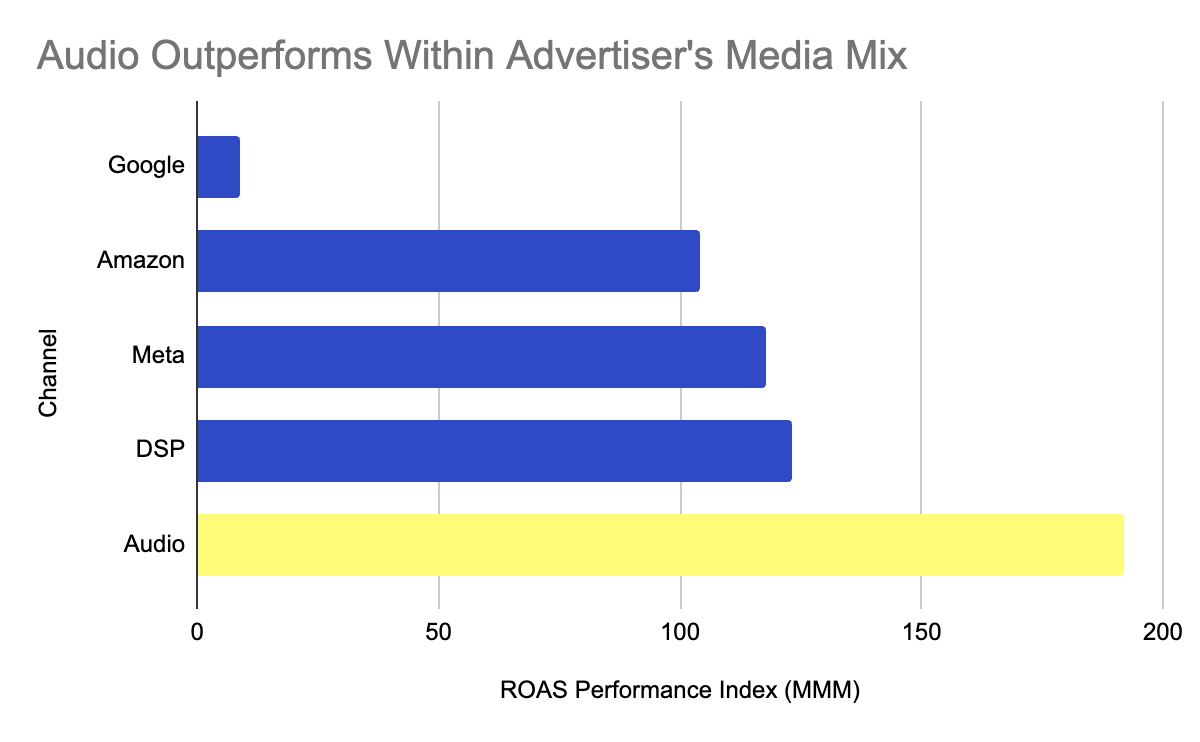
What initially looked like a mediocre test became one of the brand’s most strategically valuable experiments. Measurement evolved alongside media strategy. Pixel-based attribution remained useful for show-level decisions, but MMM became the primary tool for evaluating true channel impact.
The Conclusion
This brand’s audio story demonstrates that discipline, curiosity, and a willingness to question incomplete data can unlock meaningful growth.
By expanding measurement beyond pixels and embracing MMM as a core decision-making tool, the brand uncovered the true value of audio advertising. Podcasts and streaming are now positioned as meaningful drivers of incremental growth, especially in a business where Amazon plays an outsized role in the path to purchase.
By connecting performance signals, creative insights, and advanced measurement, RSU turned uncertainty into confidence and a soft-looking test into a validated growth lever.
Sometimes the most important results are not the ones that show up neatly in-platform, but what you uncover when you zoom out. And in this case, what started as a question mark became something much bigger.
[tldr]
Turn Unclear Performance into Growth
When the data doesn’t match the story, the opportunity is usually bigger than it looks. This case study is a reminder of how the right measurement approach can uncover hidden impact, especially in audio advertising.
Facing an attribution gap? Let's chat.
[/tldr]
.webp)
.webp)
.svg)
.webp)


.png)


.webp)
.webp)
.webp)
.webp)
.webp)
.webp)