.webp)
.webp)
.webp)
.webp)
.webp)
.webp)
.svg)
.svg)
.svg)
.png)


.png)


%201.svg)

Audio Advertisers x Right Side Up
.png)
Radio often gets passed over by performance marketers—not because it doesn't work, but because it's historically been too hard to measure.
In podcast and streaming audio, pixel-based attribution has trained brands to expect weekly reporting, show-level insights, and rapid optimization cycles. Radio, by contrast, felt slow and opaque—difficult to measure with confidence and even harder to defend within performance-driven programs. Most teams moved on before the channel had a real chance to prove itself.
“Radio has always been one of the most influential channels for advertisers, but it hasn’t had access to the same level of performance measurement as digital and streaming media.” — Matt Drengler, Head of Partnerships at Podscribe
Right Side Up partnered with multiple data-centric advertisers across fintech and SMB software to challenge that. In collaboration with Podscribe, we developed and deployed a modern radio attribution framework built to deliver decision-grade reporting. We then pressure-tested it against some of the most rigorous measurement systems in the industry, including Media Mix Modeling (MMM).
The Challenge
The same core problems kept showing up across advertisers.
Meaningful performance insight took too long.
Traditional radio reporting often takes four weeks to four months to generate a "fully baked" readout. That lag delays optimizations, makes testing expensive, and forces teams to move on before a channel has a chance to prove itself.
Legacy attribution methods told an incomplete story.
Promo codes, unique URLs, and call tracking can provide directional signal, but they routinely undercount radio's actual impact. This is especially true for in-car listeners who remember the brand but not the URL—and convert later through search or other channels.
Attribution ambiguity created skepticism.
Teams might observe lifts in branded search or site traffic, but those signals were often dismissed as noise from other channels.
What these advertisers needed was radio measurement that looked and felt modern—closer to podcast and streaming attribution, with spike-based methodologies similar to TV—and reporting they could actually act on week to week.
The Solution
Right Side Up partnered with Podscribe to develop and operationalize a radio attribution framework built to meet performance marketing standards.
The objective wasn't just to prove radio "worked." It was to make radio measurable, comparable, and optimizable alongside other audio channels. Together, we focused on:
- Delivering weekly performance insights, rather than multi-week or monthly readouts
- Providing a unified view across podcast, streaming audio, satellite radio, and terrestrial radio
- Capturing conversions from listeners who were exposed to radio but converted late, without relying solely on unique URLs/promo codes
- Unlocking reporting at the creative, genre, and DMA levels to guide real optimization decisions
- Validating radio attribution against MMM, with each system running independently and evaluated on its own merits
This framework let advertisers evaluate radio with the same rigor they applied to their most scrutinized channels.
“In partnership with Right Side Up, Podscribe’s new Radio Attribution solution enables brands to finally measure radio with the same parity metrics and reporting cadence they rely on across other channels. This brings greater transparency, accountability, and confidence to every dollar spent.” — Matt Drengler, Head of Partnerships at Podscribe
The Impact
Once modern attribution was in place, radio performance became clear—and in many cases, compelling. Advertisers could finally see how radio contributed to lead generation, revenue, purchases, and ROAS alongside other audio channels.
The examples below span full-scale audio programs and more focused radio tests, showing how radio can perform across different campaign structures and objectives.
Radio delivered measurable performance at scale
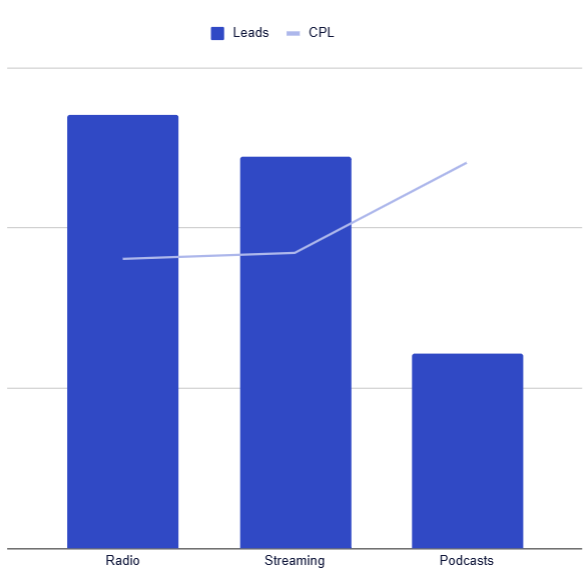
For one advertiser whose primary KPI was cost per lead, radio delivered the highest lead volume and lowest CPL of the three audio channels in the mix. Radio delivered 10% more leads and was 2% more efficient on CPL than streaming. When looking at podcasts, Radio delivered 123% more leads and a CPL that was 33% more efficient. Full-funnel attribution makes it clear: radio isn’t a vague awareness lever. It’s a performance channel.
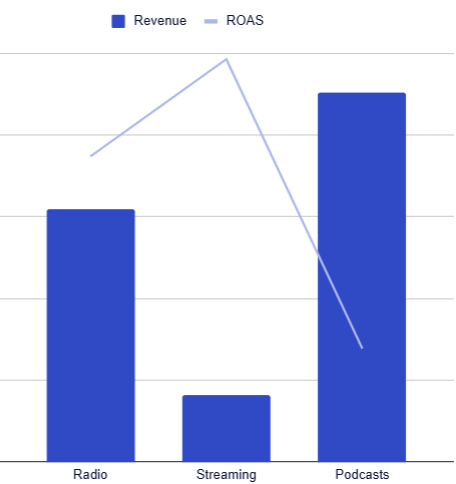
For a second advertiser focused on ROAS, the picture was more nuanced—but just as instructive. Podcasts drove the highest total revenue but also required the most spend, resulting in the lowest ROAS of the three channels. Streaming audio produced the highest ROAS but the lowest overall revenue. Radio landed in the middle on both dimensions: substantial revenue with strong efficiency, driven by well-optimized placements. Depending on the objective, any of the three channels could be the right answer, which is exactly the kind of clarity modern attribution makes possible.
Focused tests showed what specific inventory can do, for better and worse
Full-scale programs demonstrated radio's ability to sustain high volume. Shorter, more controlled tests revealed something different: how specific inventory types perform on their own.
For the two advertisers below, certain media placements ran only one to two days per week—a deliberate structure designed to evaluate individual inventory rather than always-on volume.
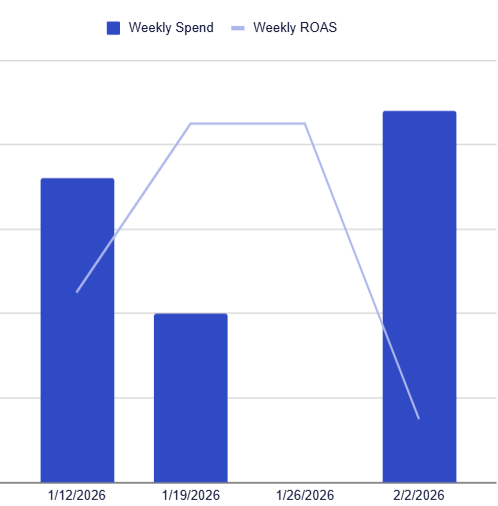
For this test, media was built around NFL Playoff inventory, with the primary KPI for this advertiser being ROAS. Over four weeks, radio ran only during game days, limiting spend while still generating a clean performance signal. Results varied week to week, as you'd expect in a short test, but the strongest week came in at 2x the ROAS goal. Equally notable: the campaign continued generating conversions during weeks when no spend was active, a clear demonstration of the lag effect that's typical of audio. Even with limited flighting, radio drove meaningful purchase volume and competitive efficiency.
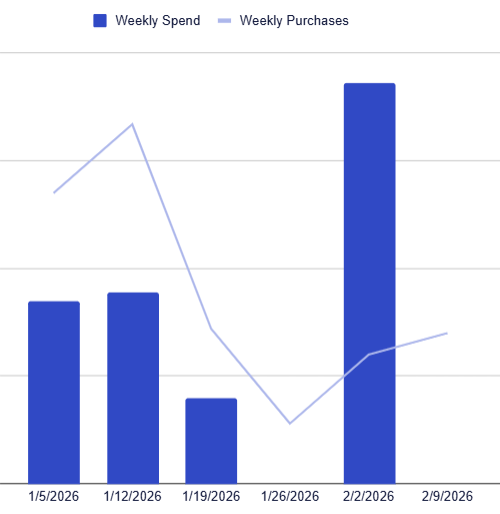
For another advertiser, we also looked at an NFL Playoff campaign, but here Radio performance was being evaluated on the KPI of purchases and focusing on their cost per purchase. The campaign didn't hit its CPP target during the initial test window, but the data told a useful story. Purchase volume held steady across multiple weeks, including periods with zero active spend. Early weeks delivered the strongest efficiency. And the campaign hit 50% of its purchase goal with just ten days on air across six weeks. For a short test under real constraints, that's a meaningful signal about what a scaled program could do.
Key Learnings
Satellite radio emerged as a consistent efficiency driver
Across two separate advertisers, satellite radio significantly outperformed terrestrial on efficiency, and the numbers made the case clearly. For one advertiser, Satellite generated 70% of terrestrial radio's revenue at just 7% of the spend. For another advertiser, their CPL came in 54% lower than terrestrial.
A gap that wide in performance helps teams rebalance budgets with confidence, rather than treating "radio" as a single, undifferentiated line item. Satellite isn't a replacement for terrestrial; it's a high-efficiency complement that should be a deliberate part of any radio plan.
Genre-level insights unlocked new growth opportunities
Genre reporting confirmed what most media buyers expected, e.g.news/talk and sports formats performed well, but it also revealed something less obvious: music formats aren't just awareness plays.
Several music genres delivered CPLs at or below blended benchmarks, opening a meaningful expansion lane beyond the initial mix. For advertisers willing to test outside their comfort zone, the upside was real.
DMA reporting surfaced pockets of outsized efficiency
Market-level data revealed significant regional variation. In some cases, smaller markets dramatically outperformed national averages. One market outside the top 50 delivered results comparable to two of the largest media markets in the country—at one-tenth the spend.
That kind of visibility into DMA-specific performance shifts the conversation from "scale everywhere" to "scale where it actually works."
Creative-level reporting changed how teams approached radio
Before this framework, the question was: does radio work? After creative attribution, the question became: what works on radio?
Teams could see real performance differences between sale copy and general informational copy, between product-specific and multi-product creative. That gave them a clear baseline for future scaling—and a much smarter way to test.
Validation through MMM reinforced confidence
As MMM models evolved to account for audio's lag effects, radio emerged as one of the most efficient channels in the mix. In one case, the MMM and the radio attribution tool reported nearly identical cost per subscription—matching down to the decimal point.
When two independent measurement systems agree, the internal conversation changes.
The Tl;dr
Radio doesn't have to be a black box. By pairing modern attribution with disciplined testing and long-term validation through MMM, Right Side Up helped performance-driven advertisers turn radio into a measurable, optimizable growth channel. With weekly insights and clear guidance on where radio works best, teams can invest with confidence, and scale what performs.
Modern attribution unlocked clear insights at every level of these campaigns: format, genre, market, and creative. Satellite radio proved to be a consistent efficiency engine. Music formats and regional markets revealed upside that legacy measurement would have missed entirely.
Most importantly: audio impact has lag. Channel specific measurement has to reflect nuances in how listeners actually behave, not just what converts in the first 48 hours.
[tldr]
Ready to Make Radio Measurable?
Whether you’re testing audio for the first time, trying to understand what’s actually driving performance, or looking for smarter ways to scale beyond digital channels, Right Side Up can help turn radio into a measurable, optimizable part of your growth mix.
Contact us today to talk through your audio strategy and measurement goals.
[/tldr]
.webp)
.webp)
.svg)
.webp)


.png)


.webp)
.webp)
.webp)
.webp)
.webp)
.webp)