No items found.
Right side up logoRight side up logo

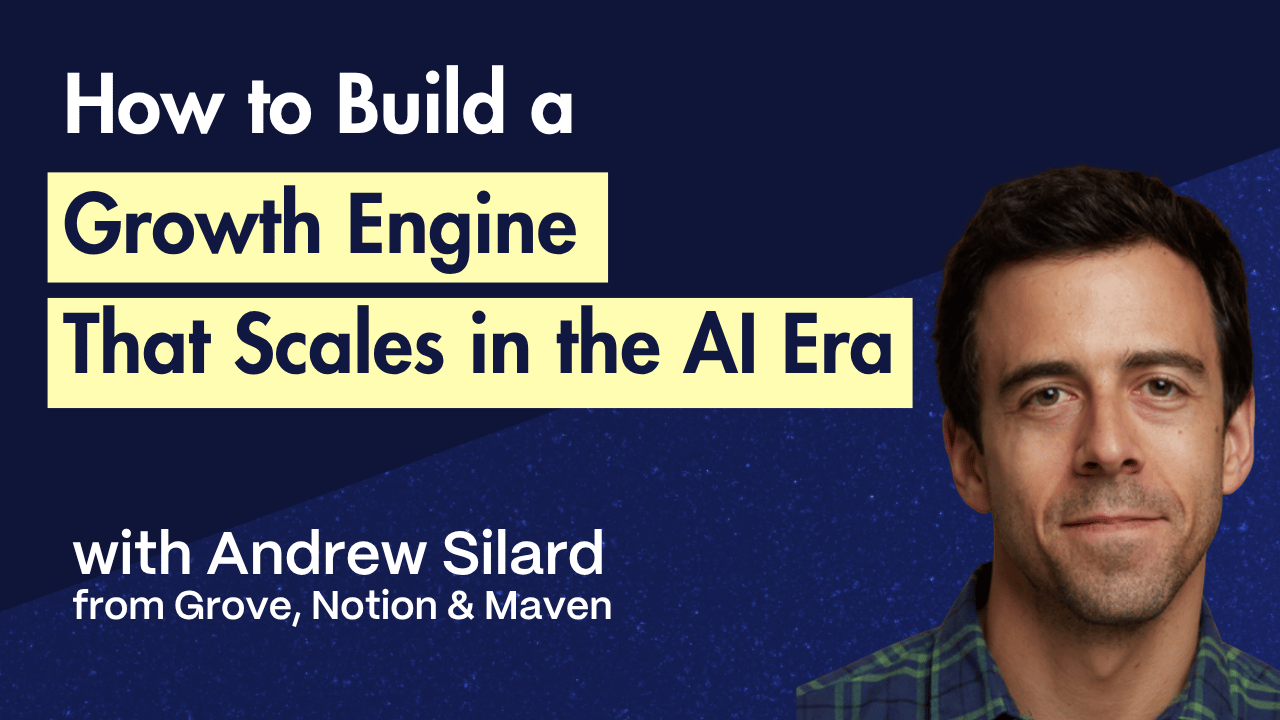
How to Build a Growth Engine That Scales in the AI Era with Andrew Silard

Published

September 15, 2026

Product-channel fit is the biggest, earliest determinant of your ability to take product-market fit into scale.

In this episode of Growth Talks, Andrew Silard, fractional head of growth and advisor to companies including Maven Clinic, OpenRouter, Just AI, and Appy, joins Right Side Up Founder and host Tyler Elliston to unpack the lessons from his time leading growth at Notion and Grove. 

Andrew breaks down why the skills that get a team to product-market fit can quietly work against it once it's time to scale, how the "spike test" reveals whether a channel is really worth doubling down on, and why marketing's job is to be the loudest voice for the customer inside the company. He closes with a candid read on where AI is genuinely earning its keep in marketing today, and where it's still mostly hype.

🗝️ Key Takeaways

  • Exploration and exploitation call for different skills. The scrappy experimentation that gets a company to product-market fit becomes a liability once it's time to focus and scale.
  • Run a spike test before you commit. Pushing 5–10x more investment into a channel for a short burst shows whether the growth is real or you've just been under-investing.
  • Segmentation turns loose fit into tight fit. Getting precise about who you're solving a problem for sharpens positioning and unlocks sharper growth.
  • Marketing's job is to be the voice of the customer. Pairing data with real customer conversations is what earns marketing a seat in cross-functional decisions.
  • AI's clearest wins in marketing are still narrow. Slack-based agents and a shared "context brain" are delivering value now; fully AI-native marketing teams are still mostly aspiration.

⏰ Timestamps

00:00 Welcome & Introducing Andrew Silard
00:50 Building Growth Across Startups: Lessons from Notion and Grove
01:20 Exploration vs. Exploitation: The Two Phases of Growth
05:09 Signs You're Stuck in Exploration Mode
07:53 The Spike Test: Validating Product-Channel Fit
16:55 Understanding Marginal CAC and Incrementality
18:13 Segmentation, Positioning, and Go-to-Market Strategy
24:49 Marketing as the Voice of the Customer
28:15 Where AI Is (and Isn't) Delivering Value in Marketing
32:16 AI Agents in Slack and the Rise of Devin
36:22 Building an AI-Native Marketing Team: Buy vs. Build
41:19 Should Growth Teams Go All-In on AI?
44:14 A/B Test
45:38 Growth Strategy in 2026: Efficiency vs. Growth
48:59 Building Early-Stage Marketing Teams in the AI Era

🔗 Mentioned in this episode

Notion: https://www.notion.com/
Grove Collaborative: https://www.grove.co/
Maven Clinic: https://www.mavenclinic.com/
OpenRouter: https://openrouter.ai/
Reforge: https://www.reforge.com/
Cognition (Devin): https://www.cognition.ai/

We'll be dropping episodes every other week. Want to follow along and listen to new episodes when they're released? Subscribe to Growth Talks on YouTube or wherever you get your podcasts.
FAQ

What is the difference between exploration and exploitation in a growth strategy?

Exploration is the work of finding a repeatable growth motion: testing positioning, channels, onboarding approaches, and customer segments. Exploitation begins once a company has enough evidence that a motion works. At that point, fractional head of growth Andrew Silard recommends concentrating on one or two bets—often just one—and building the capabilities to scale it well. That involves more than increasing marketing spend: teams may need to improve activation, lifetime value, product experience, or viral loops. The challenge is not to abandon experimentation altogether, but to deliberately separate it from the focused work of scaling a proven lever.

How can a spike test validate product-channel fit?

A spike test increases investment in a promising channel by roughly 5–10x for a short period to see whether results rise in a meaningful, roughly proportional way. For paid channels, that may mean a significant temporary budget increase. For organic channels, it could mean launching more partnerships or activating a larger referral effort at once. If signups or revenue respond clearly, the team has stronger evidence that the channel can scale. If results barely move, the issue may be weak channel fit or gaps in onboarding, conversion, or monetization that need attention before more investment makes sense.

What should marketers measure when increasing channel investment?

When deciding whether to scale a channel, marketers should look beyond blended CAC and focus on marginal CAC: the cost of acquiring the next customers generated by additional spend. A channel can appear efficient in aggregate but yield little incremental value once investment rises. Comparing normal performance with the results of a spike test helps reveal whether the extra investment is actually producing more customers. The inverse, a pause test, can also be informative: temporarily turning off a channel can show whether the outcomes it appears to drive truly disappear. These tests help teams make a more credible case for budgets, forecasts, and growth targets.

How can customer segmentation strengthen product-market fit?

Segmentation helps a company identify the customer for whom it solves the most material problem, then sharpen the positioning and experience around that audience. Andrew Silard suggests starting with customer data to find the most engaged, retained, or valuable groups, then talking directly with those customers to understand their motivations, buying journey, and unmet needs. Those insights can shape messaging, integrations, product decisions, and even payment timing. The goal is to turn broad but unfocused traction into tighter product-market fit. Teams should retain some flexibility, however, because an overly narrow segment may prove too small or difficult to scale.

How should marketing teams adopt AI without overbuilding?

Marketing teams should focus AI adoption on clearer decisions, better context, and more consistent execution—not on building every tool themselves. Andrew recommends giving teams space to experiment, while prioritizing a shared “context brain” that makes company knowledge and data easier to access. AI agents in tools such as Slack can help democratize reporting and answer questions while work is in progress. Point solutions can also improve specific workflows, such as content, lifecycle marketing, performance marketing, or website operations. For more complex needs, teams should rank the highest-value automation opportunities and evaluate build versus buy deliberately; in most cases, Andrew expects buying to be the better choice.

Episode Transcript

Let's talk growth

Get in touch

Let's talk growth

Get in touch

Let's talk growth

Get in touch

Hungry for growth?

Sign up for growth marketing insights delivered straight to your inbox